
Synthetic vs Mineral Engine Oil: Understanding the Difference
Engine oil is one of the most important fluids in a vehicle because it helps lubricate internal engine components and supports smooth engine operation. However, engine oils are not all made in the same way. Different oils are developed using different base oils, additive systems, viscosity grades and performance specifications.
Two common categories vehicle owners may come across are mineral engine oil and synthetic engine oil. Understanding the difference between these two types can help car and motorcycle owners make better decisions when selecting oil for their vehicles.
The choice should not simply be based on the idea that one type is always better than the other. The correct engine oil depends on the vehicle manufacturer's recommendations, engine design, required viscosity, API or other applicable specifications, operating conditions and the intended application.
What Is Mineral Engine Oil?
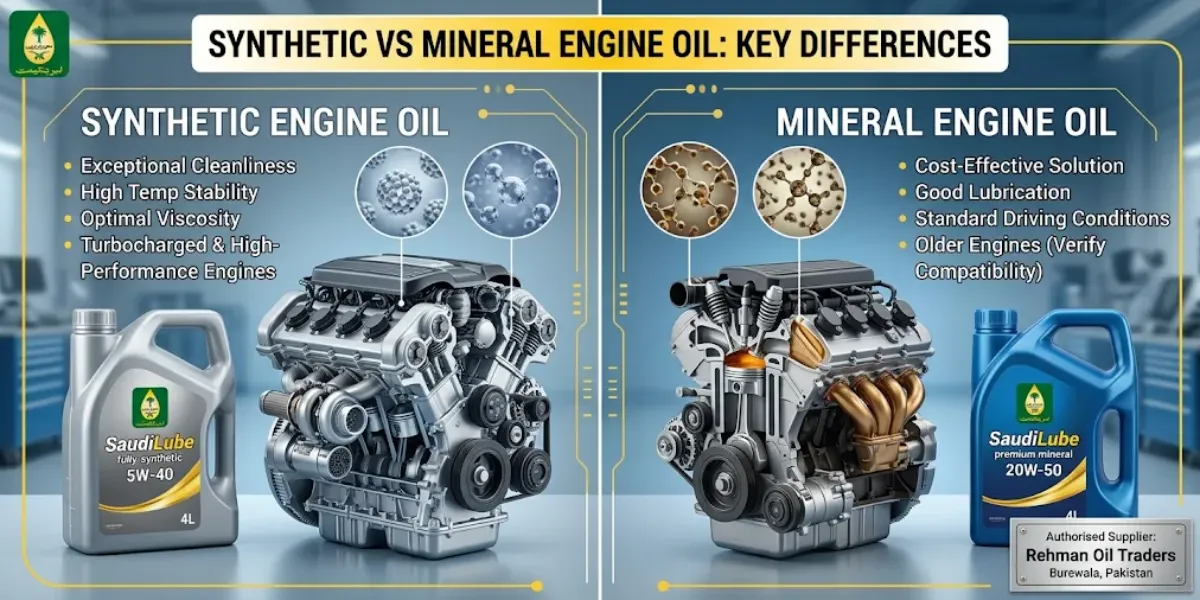
Mineral engine oil is produced from refined petroleum-based mineral base stocks. The base oil is combined with additives to provide characteristics required for engine lubrication and protection.
Mineral oils have been used in engines for many years and remain suitable for applications where the vehicle manufacturer specifies this type of lubricant.
The performance of a mineral engine oil depends not only on its base oil but also on the complete formulation. Additives can be used to support properties such as detergency, oxidation control, corrosion protection, wear control and maintaining oil cleanliness.
For older vehicles, commercial applications and engines designed around particular viscosity grades and specifications, mineral oil can still be an appropriate choice when it matches the manufacturer's requirements.
What Is Synthetic Engine Oil?
Synthetic engine oil is formulated using synthetic base stocks or highly refined base-oil technologies, depending on the specific formulation and industry classification.
Synthetic oils are engineered to provide particular performance characteristics. Their formulations can be designed to maintain desirable viscosity behaviour across different operating temperatures and provide suitable lubrication under demanding conditions.
Modern engines can have specific lubrication requirements, particularly where manufacturers specify particular viscosity grades and performance standards.
For example, a vehicle manufacturer may specify a low-viscosity oil such as SAE 0W-20 or SAE 5W-30. In such situations, the important consideration is whether the selected oil meets the required specification rather than simply choosing an oil because it is labelled "synthetic."
Synthetic vs Mineral Oil: The Main Difference
The primary difference is related to the type and processing of the base oil used in the formulation.
Mineral oils originate from refined crude petroleum base stocks, while synthetic oils use synthetic base stocks or highly refined base-oil technologies designed for specific performance characteristics.
However, the real-world suitability of an engine oil cannot be determined from the word "synthetic" or "mineral" alone.
Two oils belonging to different categories may have different viscosity grades and performance specifications. Therefore, comparing them only by their base-oil category can lead to an incorrect decision.
The vehicle manufacturer's recommended specification should always be considered first.
Viscosity Is Also Important
When selecting engine oil, viscosity is one of the most important factors to understand.
You may see grades such as:
SAE 0W-20
SAE 5W-30
SAE 10W-30
SAE 10W-40
SAE 15W-40
SAE 20W-50
SAE 50
The numbers describe the oil's viscosity classification according to SAE standards.
For example, in a grade such as 5W-30, the "5W" relates to the oil's viscosity behaviour at lower temperatures, while "30" relates to its viscosity classification at higher operating temperatures.
This does not mean that 5W-30 is automatically better than 20W-50. A vehicle designed for 20W-50 should not automatically be changed to 5W-30 simply because the latter is often associated with modern or synthetic oils.
The correct grade should be based on the vehicle manufacturer's recommendation and operating conditions.
Does Synthetic Oil Last Longer?
Synthetic formulations can offer performance characteristics that may be advantageous in certain applications, but the oil-change interval should not be decided simply by whether the oil is synthetic.
Vehicle manufacturers establish maintenance schedules based on engine design, oil specifications, driving conditions and other factors.
Frequent short trips, heavy traffic, high temperatures, dusty environments, towing, commercial use and other demanding conditions can affect maintenance requirements.
Therefore, vehicle owners should follow the recommended service interval rather than assuming that synthetic oil automatically means an extremely long oil-change interval.
Is Mineral Oil Suitable for Older Cars?
Mineral engine oil can be suitable for many older vehicles when it meets the required viscosity and performance specification.
Older engines may have been designed around particular oil grades and specifications. In such cases, selecting the correct oil is more important than simply selecting the newest or most expensive category.
If a vehicle manufacturer recommends a specific viscosity and performance level, that recommendation should be the starting point.
Vehicle owners should also consider the engine's condition, service history and operating environment when discussing oil selection with a qualified mechanic or lubricant supplier.
Is Synthetic Oil Better for Modern Engines?
Many modern engines have been developed with specific lubrication requirements, and manufacturers may recommend oils with particular viscosity grades and performance standards.
Synthetic or highly refined formulations may be used to meet certain requirements, but the correct choice still depends on the manufacturer's specification.
For example, if a modern engine requires SAE 0W-20 with a particular performance specification, simply purchasing any synthetic 0W-20 oil may not be enough. The required performance specification must also be checked.
This is why reading the owner's manual and checking the oil container's specifications is important.
What About Pakistani Driving Conditions?
Vehicle operating conditions can influence engine oil requirements.
In Pakistan, vehicles may operate in a wide range of conditions, from relatively moderate temperatures to very hot summer conditions. Traffic congestion can also result in extended periods of idling and stop-and-go driving.
Dusty roads, long-distance travel, heavy loads and commercial vehicle use can create additional operating demands.
However, hot weather does not automatically mean that every vehicle should use a thicker oil.
For example, a vehicle manufacturer may recommend SAE 5W-30 even when the vehicle is operated in a warm climate. Changing to SAE 20W-50 without checking the manufacturer's recommendation could alter the lubrication characteristics expected by the engine.
The correct approach is to consider both the manufacturer's specification and the actual operating environment.
Can You Mix Synthetic and Mineral Engine Oil?
Vehicle owners sometimes ask whether synthetic and mineral oils can be mixed.
The answer depends on the specific products and application. Some engine oils may be compatible, but compatibility does not mean that mixing different oils is always the best maintenance practice.
If you are changing from one type of oil to another, it is better to follow the vehicle manufacturer's recommendations and use an appropriate oil that meets the required specification.
When in doubt, consult a qualified mechanic or lubricant supplier before making the change.
Should You Change From Mineral to Synthetic Oil?
Changing from mineral oil to synthetic oil is not automatically necessary.
The decision should be based on the vehicle's requirements, recommended viscosity, required performance specification and operating conditions.
If the vehicle manufacturer permits or recommends a synthetic formulation that meets the required specification, it can be considered.
However, owners should avoid changing oil solely because synthetic oil is marketed as more advanced. The most expensive oil is not necessarily the correct oil for every engine.
How to Choose the Right Engine Oil
When purchasing engine oil, consider these factors:
1. Check the Owner's Manual
The owner's manual is one of the most reliable sources for determining the recommended engine oil grade and specification.
2. Check the SAE Viscosity
Make sure the viscosity grade matches the manufacturer's recommendation.
3. Check the Performance Specification
Look for the required API category or other specification listed by the vehicle manufacturer.
4. Consider the Vehicle Type
A passenger car, motorcycle, diesel vehicle and heavy-duty engine may require completely different lubricant specifications.
5. Consider Operating Conditions
Driving style, climate, traffic, load and usage pattern can all be relevant when selecting the correct lubricant.
6. Purchase From a Reliable Supplier
Buying genuine, properly labelled engine oil from a reliable source is important. Check the packaging, product information and suitability before purchasing.
Common Mistakes When Choosing Engine Oil
One common mistake is selecting oil based only on price.
Another is assuming that thicker oil is always better for an older or high-mileage engine. While some engines may require thicker grades, others may be designed for lower-viscosity oils.
Another mistake is choosing an oil simply because it says "synthetic." The required performance specification still matters.
Vehicle owners should also avoid extending oil-change intervals beyond the manufacturer's recommendations without appropriate technical justification.
What Happens If You Use the Wrong Oil?
Using an oil that does not meet the required viscosity or performance specification may affect engine lubrication and overall operation.
The consequences depend on the engine, the oil used and how the vehicle is operated. Potential concerns can include unsuitable lubrication characteristics, increased consumption, poor performance or inadequate protection under certain operating conditions.
This is why selecting the correct oil is more important than simply choosing between synthetic and mineral.
Saudi Lube Engine Oil Options
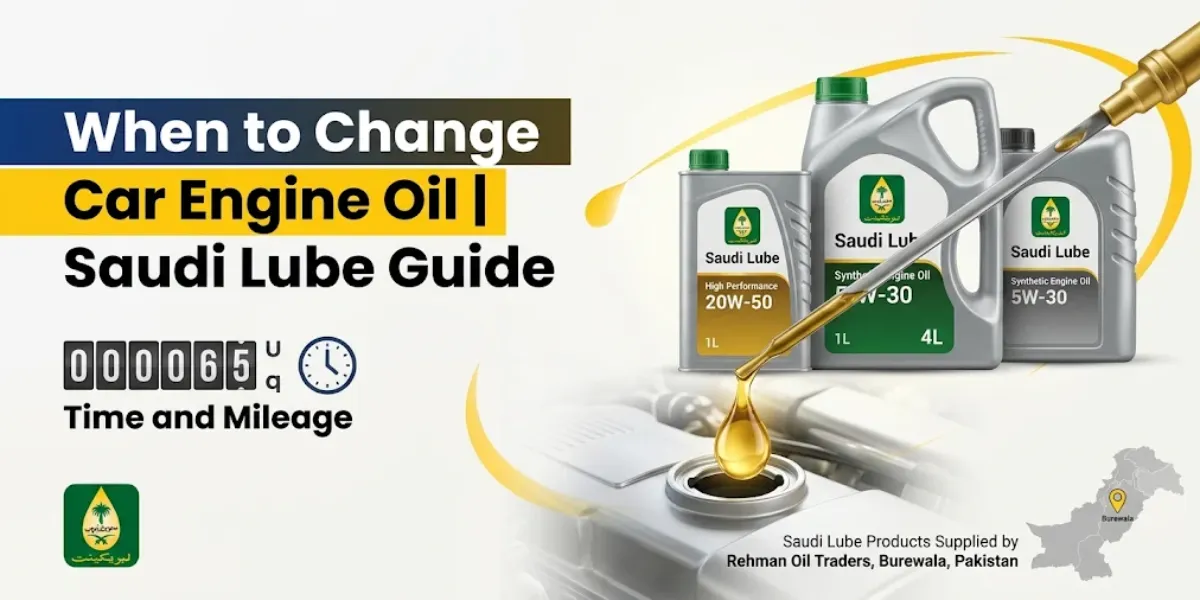
Saudi Lube provides engine oil products for different vehicle and engine applications. The available range includes products for petrol engines, diesel engines and motorcycles, with different viscosity grades and API specifications.
The gasoline range includes products such as SL-GASO-1 API SP SAE 0W-20, SL-Gaso-5 API SP SAE 5W-30, SL-Gaso-4 API SN SAE 10W-40, SL-Gaso-3 API SM SAE 10W-30 and a gasoline engine oil with API SG SAE 20W-50 specification.
For motorcycles, the Saudi Lube range includes SL-Sumama API SG SAE 20W-50 and SL-Sumama API SF SAE 20W-40.
The diesel range includes products such as SL-Diesel 6000 API CI-4 SAE 15W-40, SL-Diesel 5000 API CH-4 SAE 20W-50, SL-Diesel 4500 API CF-4/SJ SAE 20W-50, as well as other diesel engine oils in different specifications and viscosity grades.
The correct product should always be selected according to the engine manufacturer's requirements and the specific application.
Rehman Oil Traders – Saudi Lube
Rehman Oil Traders provides information and supply options for Saudi Lube engine oils in Pakistan. Customers can contact the business to ask about available products, specifications, quantities and delivery arrangements.
For customers who need engine oil for cars, motorcycles, diesel vehicles or other applicable engines, it is important to provide the vehicle or engine details when making an enquiry. This can help identify the appropriate product based on the required viscosity and specification.
Business: Rehman Oil Traders
Brand: Saudi Lube
Location: Burewala, Punjab, Pakistan
Website: www.rehmanoiltraders.com
Phone / WhatsApp: +92 310 0068195
Email: contact@rehmanoiltraders.com
Delivery arrangements and charges may depend on the order weight and delivery destination. Customers may also contact Rehman Oil Traders to discuss warehouse collection where applicable.
Frequently Asked Questions
Is synthetic oil always better than mineral oil?
Not automatically. The best engine oil is the one that meets the vehicle manufacturer's required viscosity and performance specification.
Can I switch from mineral oil to synthetic oil?
A switch may be possible, but you should check the manufacturer's recommendations and the compatibility and specifications of the new oil before changing.
Is mineral oil suitable for older cars?
It can be suitable when the oil meets the vehicle's required viscosity and performance specification.
Does synthetic oil mean I can change oil less often?
Not necessarily. Always follow the vehicle manufacturer's recommended service interval and consider the actual operating conditions.
Is 5W-30 better than 20W-50?
Neither is universally better. They are different viscosity grades intended for different applications. Use the grade specified for your engine.
Does hot weather mean I need thicker engine oil?
Not automatically. The correct viscosity should be determined from the manufacturer's recommendation and the vehicle's operating requirements.
What should I check before buying engine oil?
Check the required SAE viscosity, API or other required performance specification, vehicle application and product authenticity. Buying from a reliable supplier can also help reduce the risk of selecting an unsuitable product.
Where can I enquire about Saudi Lube engine oil?
You can contact Rehman Oil Traders in Burewala, Punjab, Pakistan, for information about available Saudi Lube products, specifications, quantities and delivery arrangements.